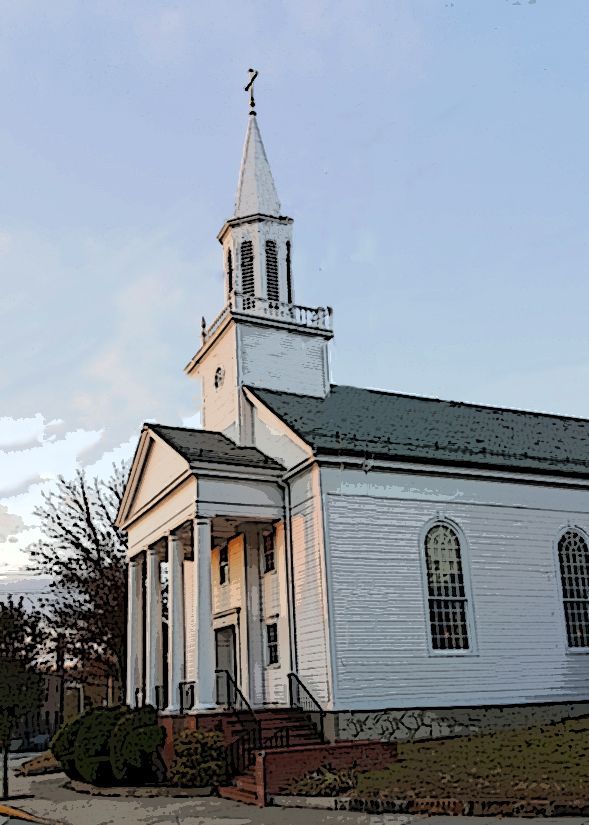
History of St. James
Two histories of St. James have been written, one for its centennial in 1932 and one for its sesquicentennial in 1982. The history written in 1982 draws heavily on its predecessor. Both histories reveal decades of St. James’ commitment to Christ and the community; they also offer glimpses into the lives of dedicated saints, ordained and lay. The timeline below offers highlights of the history of St. James.
1829
Samuel Greene becomes superintendent of mills in Bernon village; his wife, a member of St. John’s, Providence (later the diocesan Cathedral) demands Episcopal services, which are held initially in the mill, sometimes with local ministers, and then in a local school.
1832
St. James Episcopal Church in Woonsocket Falls, Smithfield, is incorporated by the State of Rhode Island and Providence Plantations by legislative act. Its first pastor, The Rev. Joseph Brown, is called. The Corporation votes to build a church.
1833
St. James Church is completed and consecrated by Rt. Rev. Alexander Viets Griswold, Bishop of Rhode Island, Massachusetts and Maine. Built above the banks of the Blackstone River, it is the first church in what will later be called Woonsocket and the eighth Episcopal parish in Rhode Island. According to church records, it measured 41 feet by 61 feet and contained 58 pews (which are owned by parishioners).
1835
Rev. Henry Waterman is called to St. James; he leaves in 1841 to serve S. Stephens Episcopal Church in Providence.
1842
The Dorr Rebellion comes to Woonsocket as St. James houses troops. Rev. Azel Dow Cole is rector. Rev. Cole later becomes president of Nashota House, an Episcopal seminary.
1845
Rev. Baylies P. Talbot begins a ministry which will last until 1865 when he is struck by lightning and dies a year later. During his ministry, membership in the church doubles and the church building is enlarged twice: in 1848 with transepts, and in 1856 in a Romanesque style.
1867
Woonsocket is separated from Smithfield.
1878
The Woman’s Missionary Aid Society is formed which later becomes the Women’s Auxiliary in 1887; the Women’s Auxiliary is the precursor to Episcopal Church Women.
1885
The rectorship of the Rev. William Sheafe Chase begins. During his seventeen-year ministry, the number of communicants doubles and work begins on St. Andrew’s Chapel in Fairmount, Woonsocket. St. James has three other mission churches: St. John’s Church in Millville, St. Mark’s Church in East Woonsocket, and St. Luke’s Church in Slaterville. St. Andrew’s Chapel remains a vibrant entity for decades. Rev. Chase later becomes a prominent national figure and moral crusader.
1888
Interest in establishing a home for the aged results in the Nightingale Home Corporation. An early benefactor is Mrs. Elizabeth Whipple, whose portrait hangs outside the rector’s study today. Though the Nightingale Home was never built, the Nightingale Fund still exists today to help those in need.
1889
The St. James Corporation votes to build a new Parish House which remains until 1961. The Parish House is a hub for community activity and includes a library, gymnasium with classes for men and women, and classes taught in English for French speakers and French for English speakers.
1907
St. James celebrates its 75th anniversary. Rev. William Ashton Thompson is rector.
1908
Rev. Charles Denfield begins a 21-year rectorship. An estate next to the church is purchased making way for a rectory and later, the present rectory built in 1962.
1923
Mrs. Annie Mason Francis is hired as a chorister but becomes choir director for 35 years. She is responsible for developing St. James’ great choral tradition.
1932
St. James celebrates 100 years of service. In attendance is Rhode Island Bishop James DeWolf Perry who is also serving the Episcopal Church of the United States as Presiding Bishop. The Rev. Augustine McCormick, who began his ministry in 1929, calls for an extensive renovation of St. James and writes a history of the church.
1938
Work starts on the renovation of St. James but a hurricane slows the renovation by causing extensive water damage.
1947
The altar painting is dedicated to the men and women of St. James who had served in the armed forces in World War II.
1950
Rev. Dana Kennedy is called. He leaves in 1954 to become media point man for the national Episcopal Church. For 13 years he moderates a nationally syndicated radio program.
1955
Rev. Federick K. Jellison begins a ministry which will last until 1980. His tenure will be the longest in St. James’ history.
1957
St. James celebrates its 125th anniversary. Rev. Jellison is quoted as saying “we not only inherit history, we must create it.”
1962
The cornerstone for the new rectory is laid after a successful fund drive and the taking on of significant debt. A new Parish House is built featuring office space, classrooms, a kitchen, and large parish hall.
1972
Jane Richer and Denise Cooper become the first young women to serve as acolytes.
1975
Mrs. Doris Holt and Miss Louisa Penhallow become the first women to serve on the St. James Vestry.
1981
The Rev. Prescott Beach is called, but he dies in 1985. The Prescott Beach Food Bank, a testament to his ministry, continues to provide food assistance to this day.
1988
Miss Nancy Hudson serves as the first female Senior Warden in the history of St. James.
1997
Rev. Eletha Buote-Grieg is called as St. James’ first female rector.
2007
Construction of a significant renovation to the Parish House begins. The Atrium brings handicapped accessibility to St. James as well as fire safety, additional space for meetings, and increased storage space.
2018
St. James begins a partnership with St. Mark’s Lutheran Church, Woonsocket. We share a pastor, participate in shared summer worship services, and collaborate on ministries. The partnership ends in 2024 with the Holy Closure of St. Mark’s.
2020
Worship services are suspended due to the Covid pandemic. The years following the pandemic see average Sunday attendance gradually rising.